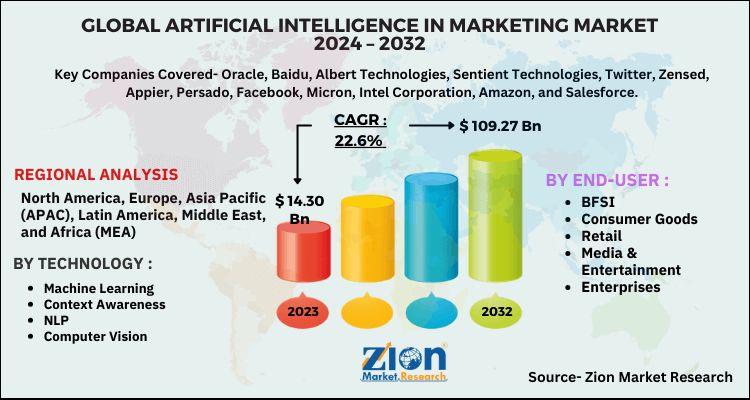
The marketing world is in the midst of a seismic shift. Gone are the days of purely intuition-based campaigns and broad demographic targeting. Today, a new, powerful partner is reshaping every facet of the industry: Artificial Intelligence in Marketing Market (AI). The global AI in marketing market, valued at approximately $21.5 billion in 2024, is projected to explode to over $150 billion by 2030, growing at a staggering CAGR of 35%. This isn’t just a trend; it’s a fundamental reinvention of how brands connect with consumers.
Beyond Automation: The Core Capabilities Driving Growth
AI in marketing moves far beyond simple task automation. It’s about intelligent augmentation, powered by machine learning (ML), natural language processing (NLP), and predictive analytics. Here’s where it’s making the biggest impact:
-
Hyper-Personalization at Scale: AI analyzes vast datasets—browsing behavior, purchase history, social media interactions—to create dynamic customer profiles. This allows for real-time personalization of website content, email campaigns, product recommendations, and ads. Think Netflix’s “Because you watched…” or Amazon’s eerily accurate suggestions, but for every customer touchpoint.
-
Predictive Analytics & Consumer Insights: AI algorithms can forecast future consumer behavior, from churn risk to lifetime value and likely next purchases. This allows marketers to be proactive, targeting high-value segments with precision and retaining customers before they leave.
-
Content Creation & Curation: Generative AI tools are revolutionizing content marketing. They assist in drafting copy, creating social media posts, generating blog ideas, and even producing basic images or videos, freeing human creatives to focus on strategy and high-concept work. AI also powers dynamic content curation for individual users.
-
Programmatic Advertising & Optimized Ad Spend: AI drives real-time bidding (RTB) platforms, placing ads in front of the right user at the right time on the right channel at the optimal price. It continuously tests and optimizes thousands of ad creative variants, headlines, and CTAs to maximize click-through and conversion rates.
-
Conversational Marketing & Chatbots: AI-powered chatbots and virtual assistants provide 24/7 customer service, answer queries, guide purchases, and collect lead information, creating seamless, immediate engagement.
-
Search Engine Optimization (SEO): AI tools analyze search trends, competitor strategies, and algorithm updates to recommend content topics, optimize keywords, and improve technical SEO, helping brands win the visibility race.
Market Drivers: Why AI Adoption is Accelerating
Several key factors are fueling this explosive growth:
-
Data Deluge: The exponential growth of consumer data is impossible for humans to parse manually. AI is the only scalable solution to derive meaning.
-
Demand for Personalization: Modern consumers expect brands to understand their individual needs. AI makes one-to-one marketing economically viable.
-
Pressure for ROI & Efficiency: In an uncertain economy, CMOs must prove marketing’s direct impact on revenue. AI provides granular attribution and optimizes spend for maximum return.
-
Advancements in AI Technology: Increased accessibility of cloud-based AI platforms, pre-built models, and no-code tools have democratized AI, making it available to businesses of all sizes.
Challenges and Ethical Considerations
The path forward is not without obstacles:
-
Data Privacy & Regulation: Navigating GDPR, CCPA, and evolving privacy norms requires transparent and ethical data use. “Cookieless” marketing strategies are pushing AI to find new, privacy-first signals.
-
Integration Complexity: Marrying AI tools with legacy CRM, CMS, and analytics platforms can be a technical hurdle.
-
Skill Gap: There is high demand for talent that understands both marketing fundamentals and AI capabilities.
-
Brand Safety & Bias: AI models can perpetuate biases present in training data, leading to skewed or inappropriate targeting. Human oversight remains crucial.
The Future: AI as the Ultimate Marketing Co-Pilot
The future of AI in marketing is not about replacement, but collaboration. The winning formula will be “HI + AI“—Human Intelligence guided by Artificial Intelligence. Marketers will shift from executors of tasks to strategists and interpreters of AI-driven insights.
We will see the rise of autonomous marketing agents that plan, execute, and optimize cross-channel campaigns with minimal human intervention. AI will also deepen its role in synthetic media, voice search optimization, and predicting macro-trends before they emerge.
Read More-
https://www.zionmarketresearch.com/de/report/zero-emission-vehicle-market
https://www.zionmarketresearch.com/de/report/artificial-intelligence-robots-market
https://www.zionmarketresearch.com/de/report/car-leasing-market
Conclusion
The AI marketing market is more than a sector—it’s the new operating system for the entire industry. For businesses, the question is no longer if to adopt AI, but how quickly and strategically they can integrate it. The brands that succeed will be those that harness AI’s power not just for efficiency, but to foster genuine, personalized, and human-centric connections at a scale never before possible. The revolution is here, and it is intelligent.